
Official KANTE help
Help with your KANTE planter.
4 minute read · KANTE guide
A useful planter shortlist begins with the place it will occupy. Compare the outside footprint, the opening your plant needs and the number of pieces you intend to use, then choose the form and finish that suit the setting.
This guide brings those checks together so you can move from a room or porch idea to the exact product details with a clear purpose.
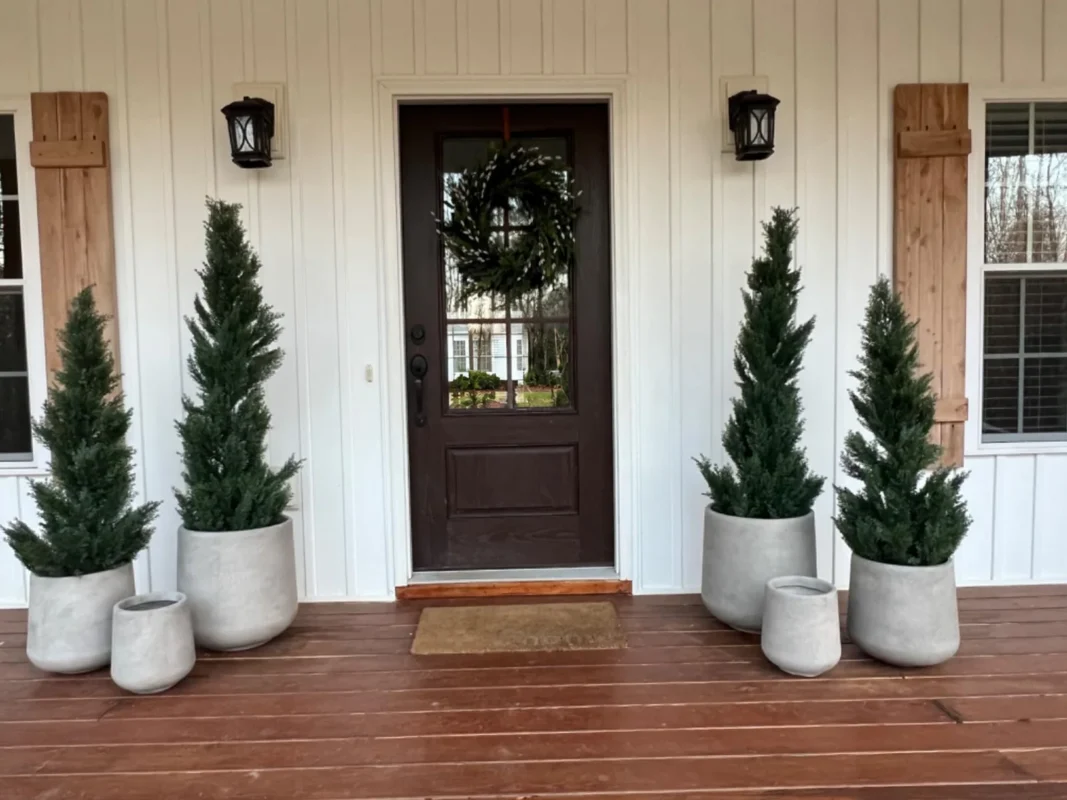
Different planter heights create a balanced group on either side of the door.
1. Choose the right material
Begin with the material listed for the model. A pale color or stone-like finish does not tell you what a planter is made from.
Concrete planters offer tall, rounded and bowl forms in the current KANTE collection. Plan a heavy container’s final position before filling it and follow its handling instructions. The separate plastic range includes models with different supplied parts and planting arrangements.
Compare the material, listed weight, included parts and intended setup together. Choose by the product information as well as the look. For more on form, surface and scale, explore our concrete planter design and material guide.
2. Separate outside size from planting space
Read three measurements separately: the outside height, the widest outside width or diameter, and the planting opening or usable interior. Each answers a different question.
- Outside height describes how the container sits beside the door, furniture or railing.
- Outside width and depth describe the space its widest points occupy.
- Opening and interior help you compare the planter with the plant or nursery pot it needs to hold.
The opening alone does not establish whether a nursery pot fits farther down inside. Check both width and depth; if a measurement is missing, ask for it before ordering. The planter measuring guide walks through this comparison.
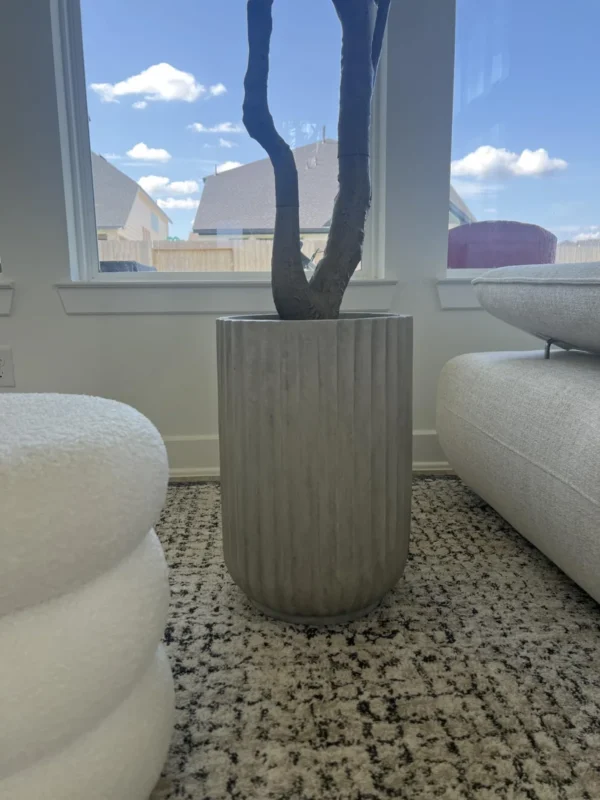
A closer view shows how the rim and vertical fluting read beside soft upholstery.
3. Check the footprint and choose a shape
Mark the proposed outside footprint on the floor with a surface-safe temporary outline. Open the nearby door, pull out the chair and walk the usual route. Include the plant’s expected spread and leave access for care.
A rounded outline can soften the edge of an arrangement; a square form can echo straight architectural lines. Both still need their widest dimensions checked. A narrow base is not the same as a small overall footprint.
Use the scene photograph to judge the relationship between objects. Use the exact product’s measurements to decide what fits.
4. Compare finishes using the exact product
Let the surroundings help you choose a finish. White can provide contrast beside dark siding or timber; Weathered Concrete can connect with textured stone and wood; darker finishes can pick up window frames or furniture.
Then check the actual product photographs for the selected model and finish. Lighting and screens influence how a scene appears, and the supplied guidance describes any relevant surface or dimensional variation. A shared finish name does not make two models the same size.
5. Confirm drainage and the number of planters
Read the included quantity before planning a pair or group. Several containers in a styled photograph do not mean that one listing supplies them together. Plants and scene accessories are not included unless the listing says otherwise.
Also identify the drainage arrangement for the exact model. A concrete planter with a drainage opening and rubber plug is a different setup from a model supplied with removable inner nursery pots. Decide how you will check for and remove collected water in the chosen location.
For the practical routine, read the check after watering.
6. Check the details before ordering
Keep a short note beside the product details: model, material, selected finish, outside dimensions, opening and included quantity. Compare it with the retailer’s selected variant before ordering.
The product page provides the route to the corresponding retailer listing. Current price, availability, delivery and purchase terms are provided there. Keep the order confirmation and supplied instructions for future reference.
A few common questions
Are all KANTE planters concrete?
No. KANTE offers concrete and plastic planters. Read the material listed for each model rather than relying on color or shape.
Does a size in the product name describe the planting opening?
Not necessarily. It may describe height or overall diameter. Read the labeled measurements. For the 21.7-inch round bullet model, 21.7 inches is height and the top opening is listed separately at 13.7 inches.
Does a picture of several planters mean they come as a set?
No. Check the included quantity on the specific listing before ordering, especially when planning a pair. Plants and other scene accessories should not be assumed to be included.
Can a concrete bowl planter be used as a fire pit?
No. These planters are for planting use only. Do not use them as a fire pit, fire bowl or fireplace, or expose them to open flames or high heat. Read the care and safety information before use.
A useful shortlist is one you can describe clearly: the position, the planter’s outside size, the opening your plant needs and the number of pieces to order. Keep those notes beside the exact product details as you compare.
Continue reading
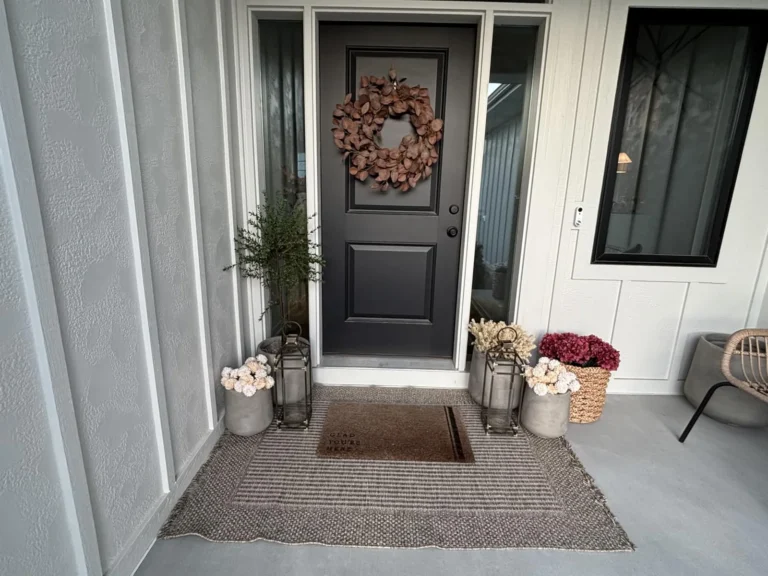
How to Measure a Space for Round or Square Planters
Measure the space around doors and furniture, compare outside dimensions and planting openings, and choose a planter shape that leaves room for everyday movement.